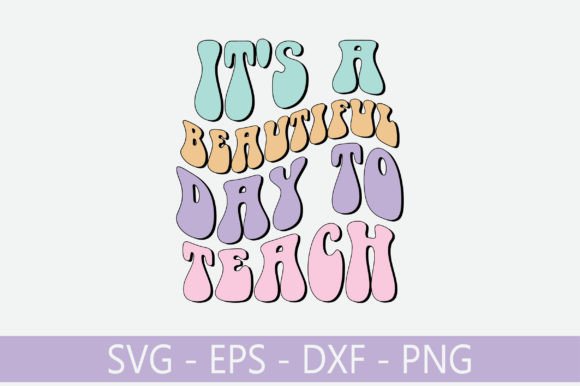
It s a Beautiful Day to Teach Retro Svg
As an embroidery designer who spends half my life staring at stitch charts and the other half worrying about client expectations, I approach every new design file with a mix of optimism and skepticism. We have all seen it before: a cute graphic on a screen that looks charming in vector form but turns into a muddy, tangled mess once the needle starts moving. That is why I take a close look at It s a Beautiful Day to Teach Retro Svg before committing it to fabric. This isn’t just about whether the letters are legible; it is about how the design translates from a digital asset into a tangible, high-quality handmade product.
The category here is clearly Crafts and Graphics, which tells me this is intended for makers, Etsy sellers, and small business owners who need versatile assets. But "versatile" can mean many things. Does it work as a subtle accent? Is it bold enough to stand alone? When I first opened the files included in this download—SVG, EPS, DXF, and PNG—I was looking for clues about its potential in real-world applications. The retro aesthetic immediately sets a specific mood. It feels nostalgic, warm, and inviting, which is a powerful emotional hook for buyers looking for personalized gifts or boutique merchandise.
First Impressions and Visual Personality
The phrase itself carries weight. Teachers appreciate sentiment, parents love meaningful decor, and students often gravitate toward designs that feel encouraging rather than demanding. The retro styling suggests a vintage typography influence, which usually means cleaner lines and a more structured layout compared to modern script fonts. For an embroidery project, structure is your friend. Loose, overly complex scripts can be nightmares to digitize properly, leading to thread breaks and poor registration. A retro geometric or block-style approach tends to hold up better under the tension of machine stitching.
Visually, the design likely balances text and perhaps some accompanying graphical elements. If there are decorative accents, I am always checking their scale. Are they too tiny to stitch clearly? Do they compete with the lettering for attention? In my experience, the most successful embroidery project designs have a clear focal point. If this design allows the message to breathe while still offering enough visual interest to catch the eye on a rack of custom apparel, it has passed the first test.
Real-World Application Scenarios
Let’s talk about where this design actually lives. I recently considered using a similar retro teacher-themed motif for a batch of custom tote bags for a local school fundraiser. Tote bags are a staple for any craft business. They are durable, practical, and serve as walking billboards for your brand. However, they present unique challenges. The canvas material can be thick, requiring a strong stabilizer and a sharp needle. If the It s a Beautiful Day to Teach Retro Svg design has dense fill areas, it might become stiff and uncomfortable to carry. But if it relies more on clean satin stitches for outlines and lighter fill stitches for background elements, it would drape beautifully.
Another scenario that comes to mind is creating personalized gift items for back-to-school season. Think embroidered patches for denim jackets or sweatshirts. Sweatshirt embroidery is a popular niche because the fabric is forgiving, but it also hides minor imperfections less effectively than tight-woven cotton. If the design includes fine details, you want to ensure those details remain crisp. I often advise clients to think about the end user. A student receiving a hoodie with this design will likely wear it frequently. Does the design age well? Retro styles tend to have longevity, avoiding the trap of looking dated within a year.
For Etsy sellers and small shop product creators, this design could easily translate into home decor. Pillow covers and kitchen towels are excellent entry-level products. They require less precise fitting than garments, making them easier to produce in bulk. Imagine a set of tea towels featuring this design in a soft, muted color palette. It fits perfectly into the current trend of cozy, functional aesthetics. The key here is consistency. If you are building a brand around educational themes, having a cohesive library of design assets like this one helps maintain professional recognition.
Technical Considerations and Stitch Clarity
No matter how beautiful a graphic looks in Photoshop, the true test is the hoop. When evaluating It s a Beautiful Day to Teach Retro Svg, I pay close attention to the stitch density. Too much density on a single area can cause puckering, especially on lightweight fabrics like baby clothes or thin cotton blends. Conversely, too little density can result in a sparse, unfinished look where the base fabric shows through. Since the download includes DXF and SVG formats, you will need to import these into your digitizing software to adjust the stitch types appropriately.
You should consider the difference between a satin stitch and a fill stitch. Satin stitches are great for outlining text and creating sharp edges, while fill stitches are used for coloring in larger areas. If the retro design relies heavily on filled blocks of color, ensure that the underlying underlay stitches are robust enough to stabilize the fabric. This is particularly important when working with stretchy fabric or knits, which are common in baby embroidery and sportswear. Without proper stabilization, the design will distort, ruining the professional finish.
I also recommend testing the design in black and white mockups before ordering thread. This helps you assess the contrast and balance without the distraction of color. Sometimes, a design looks vibrant in red and gold but lacks impact in navy and white. Checking the thread colors against different fabric texture options is crucial. Dark fabrics often require a lighter thread or a contrasting border to make the design pop, while light fabrics allow for deeper, richer tones.
Where to Use With Caution
While this design has broad appeal, there are certain applications where you should proceed carefully. Small hoop sizes can cut off delicate details or make lettering too small to read comfortably. If you are aiming for a miniature patch, verify that the smallest elements of the design are large enough to be stitched accurately. Textured fabrics, such as terry cloth or heavy denim, can obscure fine lines. In these cases, a simpler version of the design or a larger scale may be necessary.
Curved surfaces like caps and hats add another layer of complexity. The curvature can distort straight lines and circular shapes. If the retro design includes geometric elements, ensure they are adjusted for the curve during the digitizing process. Additionally, products that need frequent washing, such as aprons or dish towels, benefit from denser stitching and higher-quality threads to prevent fading and fraying over time.
Final Thoughts for Makers and Sellers
Ultimately, It s a Beautiful Day to Teach Retro Svg offers a strong foundation for a variety of creative ventures. Whether you are producing commercial embroidery for a local business or crafting unique handmade product lines for online markets, the retro theme provides a timeless appeal. It resonates with educators, parents, and anyone who appreciates a touch of nostalgia.
Before adding this to your production workflow, remember to test on scrap fabric first. Check the hoop size constraints and inspect the small details under magnification. Confirm whether the licensing terms allow for commercial use if you plan to sell finished items. By taking these practical steps, you ensure that your final output matches the quality of the original design. This attention to detail builds customer trust and enhances the perceived value of your work. In a market flooded with mass-produced goods, a well-executed, thoughtfully designed embroidered piece stands out. It tells a story, and with a design like this, that story is one of appreciation, creativity, and style.